
Yet Another Zombie Survivors — YAZS, as both the developers and the players call it — is packed with jokes and references for every taste: from cult movies and gamer memes to darts jargon and a potato encoded in binary code. And the humor clearly lands: this indie bullet heaven roguelite from Awesome Games Studio has been holding a "Very Positive" rating on Steam ever since its 1.0 release in August 2026.
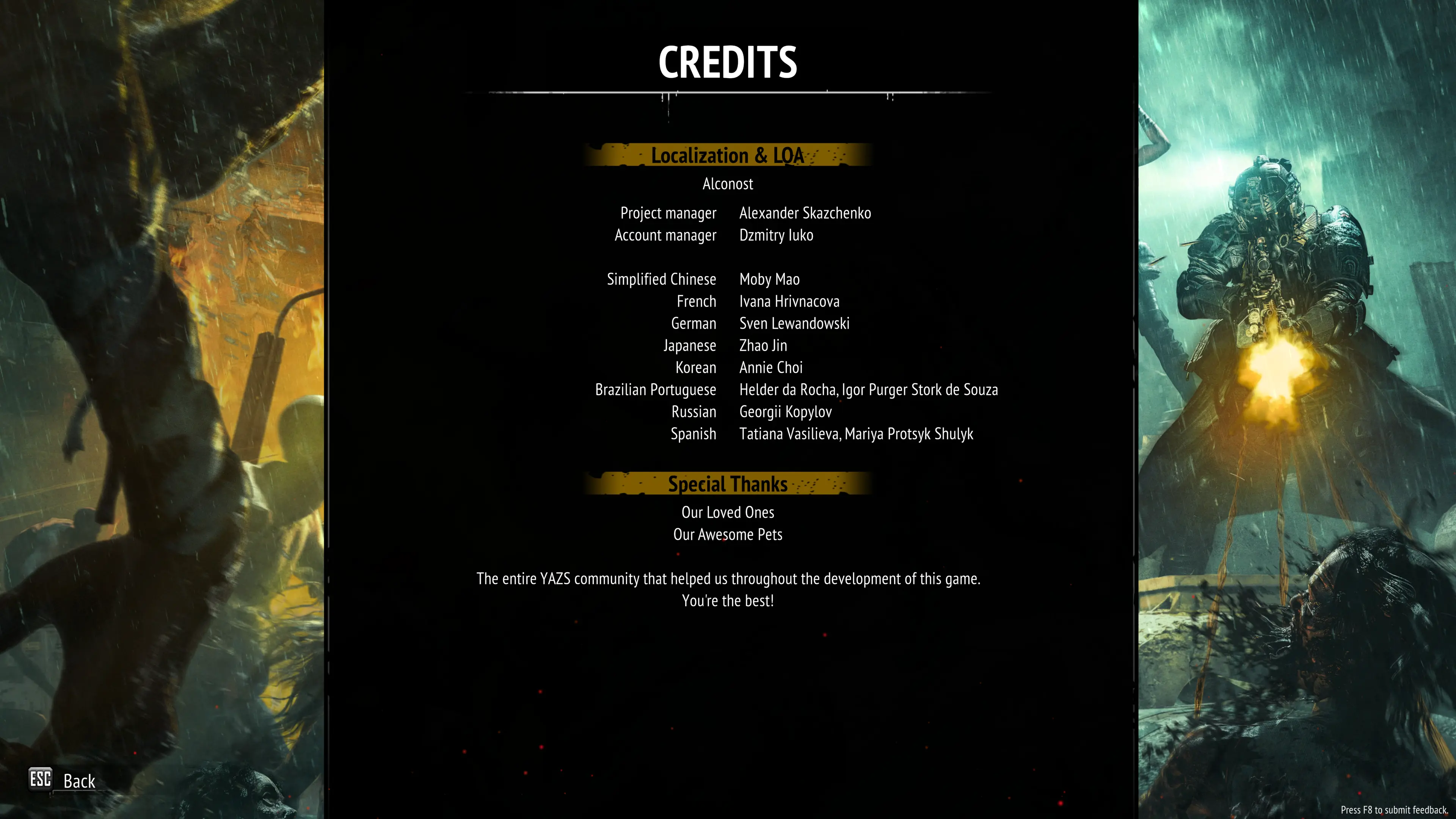
We localized YAZS into eight languages — 100% human translation, no machine output. With a game like this, that's the only setup that keeps the vibe intact. And the vibe here lives in the jokes. Translating one means understanding what it's for — and rebuilding that effect for a new audience. That's called creative adaptation — and it carried this project.
The developers wrote the Polish version of YAZS themselves, so they know firsthand what translators need, and they set the project up accordingly:
- A localization kit with context notes. Nearly every reference flagged — "It's Over 9000!", "It's Dangerous To Go Alone", the binary potato (more on that later), the darts jargon — often with links to the source.
- Steam keys for the translators, from day one. Translators could check their lines against the live game, and a dedicated LQA (linguistic quality assurance) stage added the finishing touches.
- A direct line to the devs. Translators could ask the developers directly about any reference they couldn't place — and the devs, in our team's words, "were delighted to share the references whenever we didn't get them."
We brought the other half: a team of translators who are gamers themselves — people who recognize, say, a Left 4 Dead quote on sight because they've played it.
One dartboard, many translations
Items in YAZS carry flavor text — a short joke line attached to an item for personality rather than mechanics, a staple of game writing. Take the Dartboard, an item that rewards attacking enemies from a distance. Its flavor text reads: "Be a Big Fish in Annie's Attic."
Both phrases are real darts slang: a "Big Fish" is the highest possible three-dart finish; "Annie's Attic" is where you end up when your game has gone badly. In other words: aim for glory, avoid embarrassment — told entirely in pub jargon.
References don't have to land for everyone.
Our German translator Sven Lewandowski went deeper into darts slang than the original. His German version says the opposite thing in the same spirit: Wirf keine Waschmaschine oder Mülltonne — "Don't throw a washing machine or a trash can." Waschmaschine is German darts slang for the most common failed throw; Mülltonne is another infamously low-scoring one. German darts players will grin in recognition.
And everyone else? They'll read a deadpan instruction not to hurl household appliances around — which, in a game this gleefully absurd, is funny in its own right.
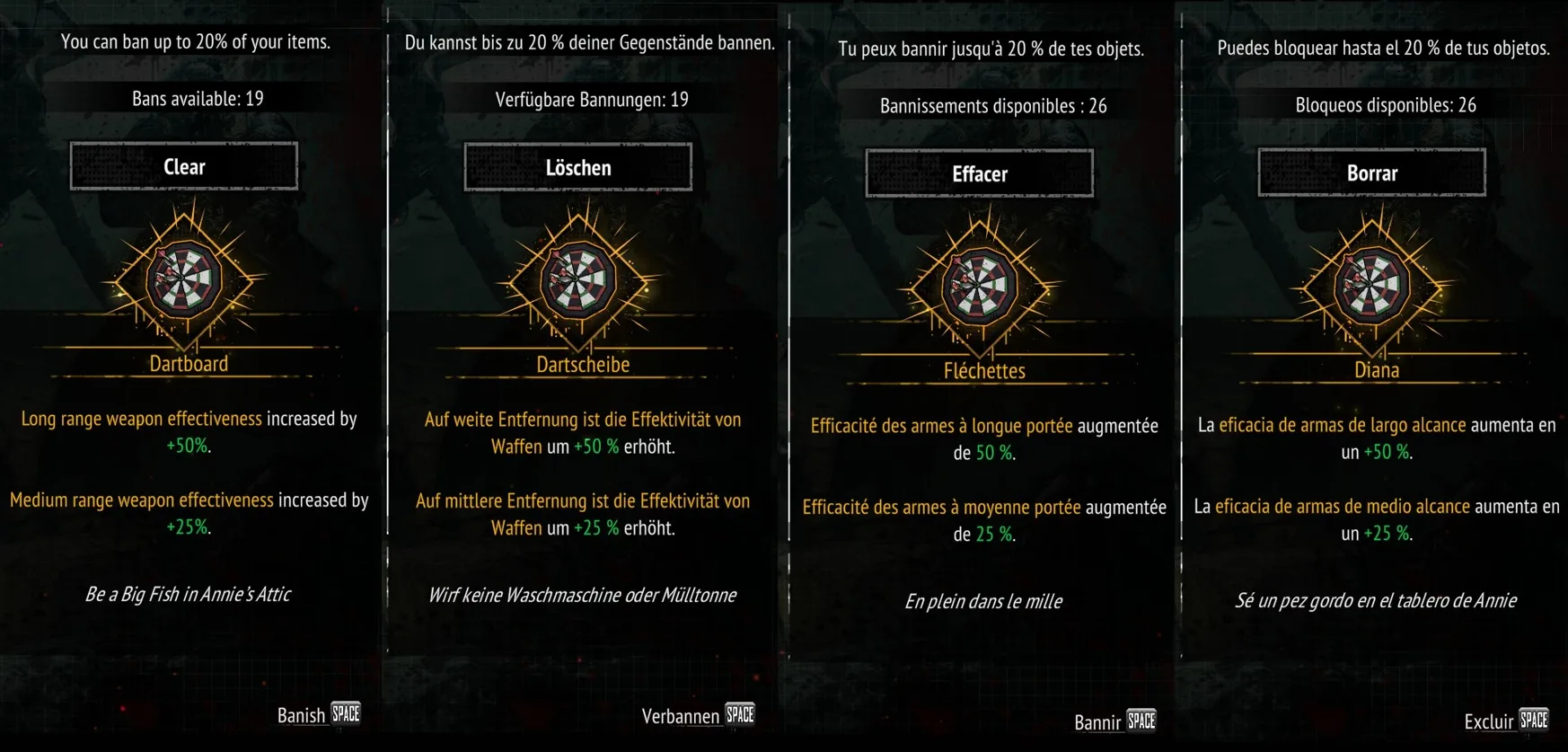
Here's how some other languages approached the same line:
- French: En plein dans le mille ("right in the bullseye") — a target-shooting idiom every French speaker knows.
- Spanish: Sé un pez gordo en el tablero de Annie. Here we get an idiom overlap: the line keeps the "big fish" literally, and in Spanish pez gordo also means "big shot" — so it works even for readers who have never held a dart.
When the joke has to go local
Some references simply don't travel. One of YAZS's achievements, Dead Rude Sandstorm, nods to one of gaming's oldest musical in-jokes: "Darude — Sandstorm," the internet's default answer to "what's this song?"
The meme never took root in Germany, so Sven rebuilt the joke on something every German grew up with instead: Drei außer Rand und Band — a twist on Zwei außer Rand und Band, the German release title of a Bud Spencer and Terence Hill comedy known as Crime Busters to English-speaking audiences. These Italian action comedies were a cultural phenomenon in Germany, largely thanks to their famously freewheeling German dubs. And why change "two" to "three"? Because in YAZS you build a squad of up to three survivors.
And what if a joke is built not on a reference but on an error? The line "A winner is you" quotes the famously broken English of the 1986 NES game Pro Wrestling — the wrong grammar IS the joke. You can't fake a grammar mistake convincingly in Chinese, so our linguist Moby did something smarter with 上面写着:"赢家就是你" ("It says: 'The winner is you'"): the phrasing is deliberately stiff and old-fashioned, echoing the clunky style of vintage bootleg cartridge translations that Chinese retro gamers know and love.
Chinese readers cannot easily spot an artificially manufactured grammar mistake, but they can recognize the stylistic texture of old game localization.
The devs set the (crow)bar
We've already said the developers wrote the Polish version of YAZS themselves — now see the sense of humor and the sharp eye for pop culture that come with it.
Take the achievement Get Rich or Die Trying (yes, the 50 Cent album): in Polish it became Grosza daj zombiakowi~ — "toss a coin to your zombie," with the word structure borrowed from the Polish version of the song from Netflix's The Witcher. The tilde at the end even marks the line as sung.
And here the project got a lucky bonus. Sven understands Polish — so when a line wouldn't crack, he could peek at the developers' own version: "whenever I hit a snag localizing, or whenever I felt like the Polish version might have a more interesting take." That's how the Witcher move travelled into German: Reichet Gold eurem Zombie~, with the structure taken, in his words, "verbatim from the actual German rendition of 'Toss a Coin to Your Witcher.'"
Or take the Crowbar. Its English flavor text puns on the word itself: "Actually not a crow, but still a bar." Three languages — three completely different ways out:
- Polish (the devs): Pół Życia Trzy potwierdzone! — "Half-Life 3 confirmed!" The crowbar is Gordon Freeman's signature weapon in Half-Life, and "Half-Life 3 confirmed" is one of the longest-running memes in gaming.
- Brazilian Portuguese: a crowbar is pé-de-cabra, "goat's foot" — so our Brazilian translator Helder da Rocha rebuilt the pun on the local name: Na verdade, não tem nada a ver com cabra, mas é forte ("actually, it has nothing to do with goats, but it is strong").
- Russian: our Russian translator Georgii Kopylov swapped the wordplay for a native proverb: «Против лома нет приёма» — "there's no defense against a crowbar," funny precisely because it's so matter-of-fact.
Earworms, forests and achievement trains
Some YAZS achievements follow song lyrics — brutal material to translate as people know songs by their original lines. A chain of achievements for surviving in a forest area tracked Mike Oldfield's "Moonlight Shadow"; the lyrics wouldn't translate, the forest theme kept slipping away — so Sven swapped the whole chain for references to a German song about… wood.
The result, Holzi Holzi Holz, references "Holz" by 257ers — an absurdist viral hit about one man's love of wood that charted in Germany in 2016. A song about wood arguably fits a forest survival chain even better than the original reference did.
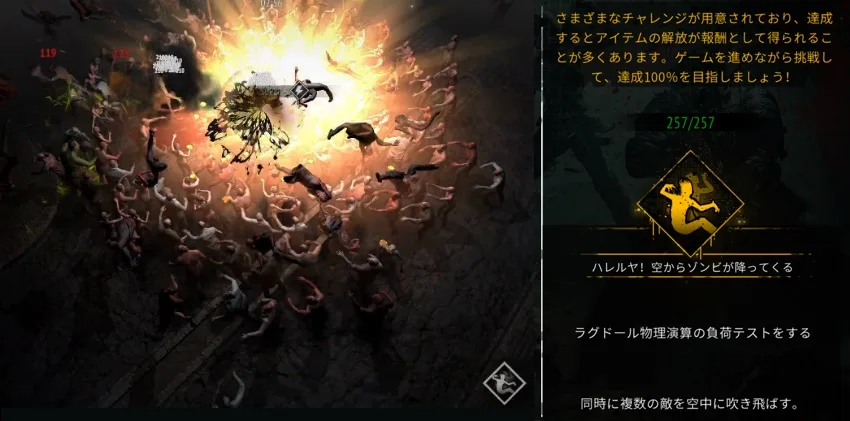
Our Japanese translator, Zhao Jin, pulled the same move on It's Raining Men — the line appears when a horde of zombies, launched into the air, comes crashing back down. His version goes: 「ハレルヤ!空からゾンビが降ってくる」("Hallelujah! Zombies are falling from the sky"). The song's single most recognizable word stays as the anchor; the rest becomes a literal description of the chaos on screen.
And then there's the achievement chain of the Dead Terminal — one of the game's maps, a railway station true to its name, which all but promises train puns. Four achievements for surviving longer and longer stretches there: Slow Train, Fright Train, Crazy Train and Bullet Train.
German Zug means both "train" and "a move," and Sven built the first three into a military micro-story:
- Einzug (marching in) →
- Schlachtzug (a battle campaign — and, handily, the standard German term for an MMO raid) →
- Abzug (withdrawing the troops).
Enter, fight, retreat: the German achievement names tell a story the English ones don't.
The fourth achievement is where he deliberately broke his own pattern: Zug um Zug is the German title of the railway board game Ticket to Ride. Why abandon a perfectly good system at the finish line? "I had a few options here, but this one just sounded the coolest, to be honest," says Sven.
Same meme, opposite decisions — and both are right
How does a translator decide a meme's fate? Our Chinese translator Moby weighs two things:
- How widely a reference is known among Chinese players
- Whether keeping the original joke actually serves the line's function
If the meme already has an established, widely accepted Chinese name or quote within Chinese gaming communities, I keep the original reference and use its common local translation. But if the joke heavily relies on Western cultural background and most Chinese players cannot catch the humor even with a literal translation, I will consider local adaptation.
Now watch one line land differently in every market — the Health Potion's flavor text: "Tastes like strawberry and puts the phoenix down." The pun: "Phoenix Down" is Final Fantasy's iconic healing item, named after the bird's feathers — and "putting down" is what you do to a sick animal.
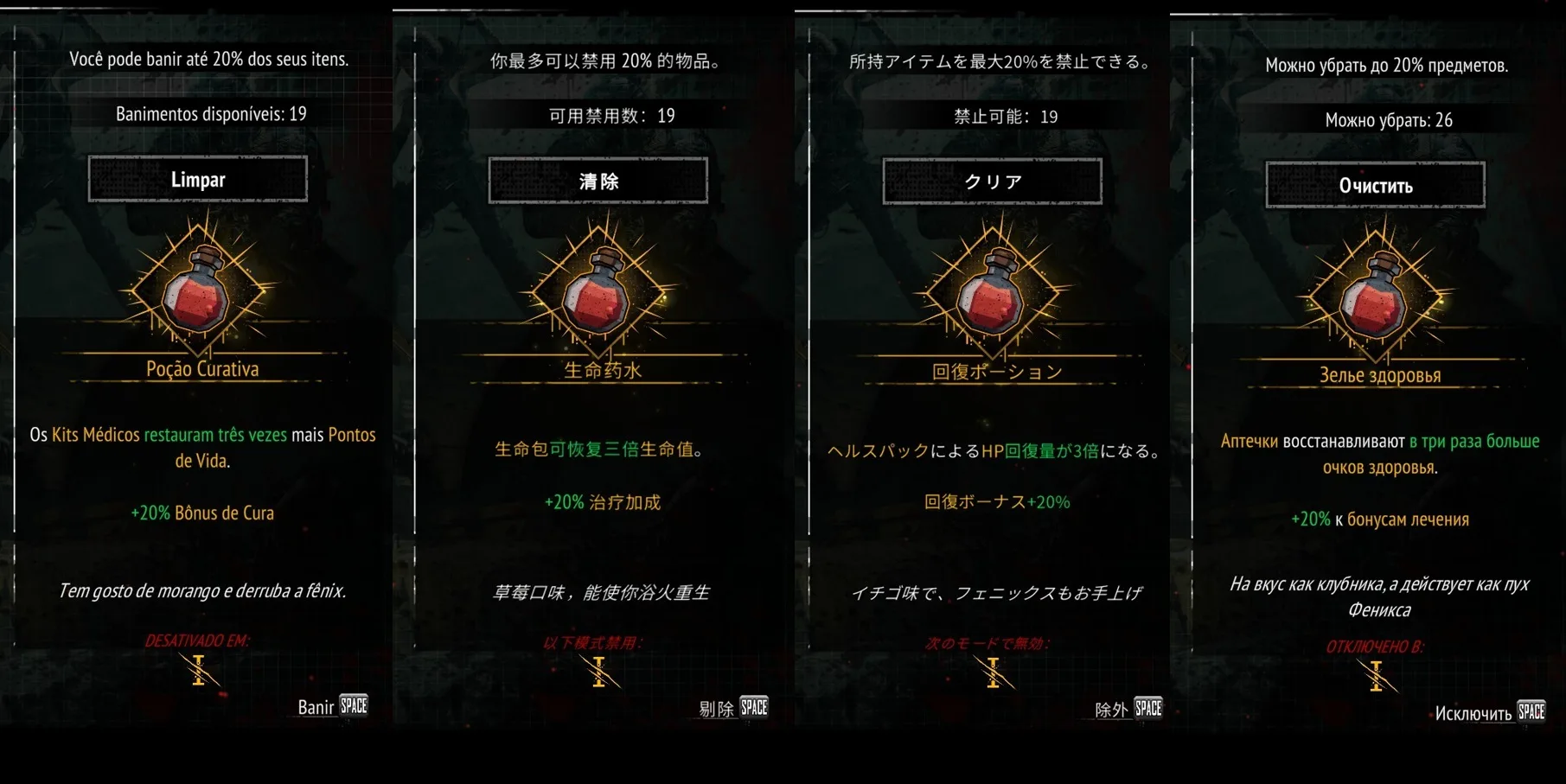
Here's how the languages handled it:
- Brazilian Portuguese: Tem gosto de morango e derruba a fênix ("tastes like strawberry and knocks the phoenix down"). The joke about the bird survives almost intact; Spanish "Sabe a fresa y derriba al fénix" made the same call.
- Chinese: 草莓口味,能使你浴火重生 ("strawberry-flavored — lets you be reborn through fire"). Moby kept the mythology: 浴火重生 is a well-known idiom about the phoenix reborn in flames. "Many Chinese players may not be familiar with this specific FF reference," he explains — so the bird stays, the item name goes.
- Japanese: イチゴ味で、フェニックスもお手上げ ("strawberry-flavored — even the phoenix throws in the towel"). The phoenix stays, defeated in a new way.
- Russian: На вкус как клубника, а действует как пух Феникса ("tastes like strawberry and works like Phoenix Down"). Our Russian translator Georgii Kopylov kept the Final Fantasy item under its official Russian name, пух Феникса; the double meaning of "put down" is lost.
That was one of the hardest references for me, and one I feel I never fully cracked. The main problem with memes is that in many cases there is no established, unambiguous Russian translation, even for major games.
- German: Schmeckt nach Erdbeere und hebt die Stimmung ("tastes like strawberry and lifts your spirits"). Sven let the reference go — deliberately. First he tried to keep it but couldn't make the pun work grammatically, and besides: "The connection to Phoenix Down was already a little tenuous in my mind, because the item in question is a health potion, not a revival potion." So he wrote a line about what the item actually does.
Sometimes the layers even split between translators. The achievement "Of Birbs and Puppers" does two things at once: its structure parodies Steinbeck's "Of Mice and Men," and its words are the deliberately misspelled cutesy dialect of internet animal memes ("birb" for bird, "pupper" for puppy).
Working independently, our Brazilian translator Helder da Rocha saved the meme layer — De Passarinhus e Cachorrinhus, with the wrong -us endings mirroring Brazilian internet baby-talk exactly — while Georgii saved the literary one: О пернатых и лохматых echoes the canonical Russian title «О мышах и людях». Each of them heard the layer of the joke his audience would hear.
Binary potato: the strings with no words in them
One line in the YAZS files arrived seemingly with nothing to translate. One of the twenty random quotes on the defeat screen reads "010100000100111101010100010000010101010001001111". Decode it from binary ASCII and it says POTATO.
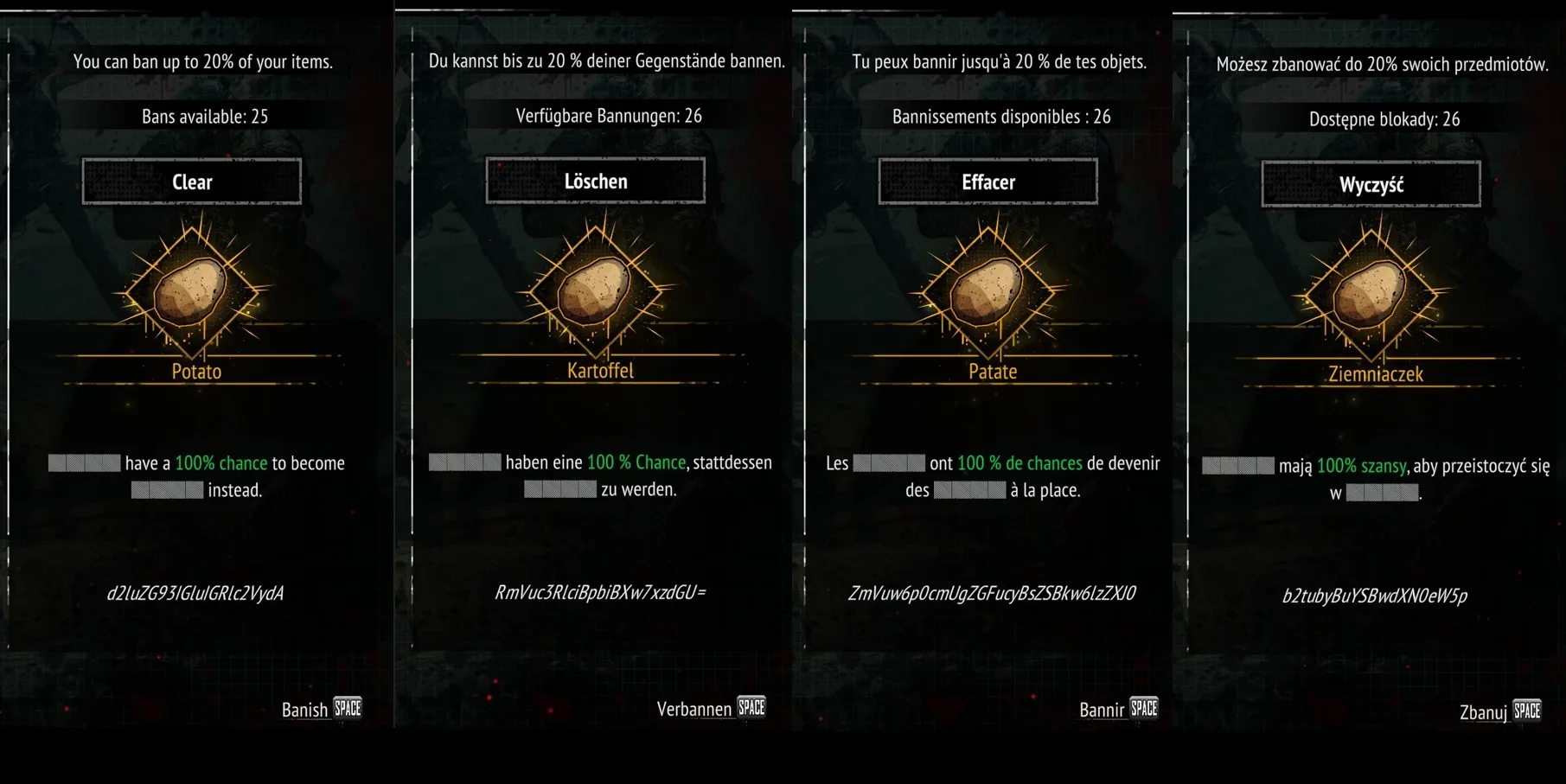
When a game talks in machine code, it's a nudge for attentive players, and for everyone else just a goofy way to be told you've died. The developers' context note told translators what the string was. What to do with it was up to them.
Each translator decoded the joke, translated it, and encoded the result back into binary. French stands out: our linguist Ivana Hrivnacova used the colloquial patate instead of "pomme de terre" from the dictionary to save some space (48 bits against 112, to be precise). And how can we not mention the original Polish Ziemniaczek? Not just "Ziemniak" but the affectionate diminutive, "little tiny cute potato".
The Potato itself is an item, and the mystery continues there: even its description has the key words blacked out, and its flavor text is encoded again, this time in Base64: d2luZG93IGluIGRlc2VydA, which unpacks to "window in desert". As you can see on the screenshot, every language hides its own translation in the same way.
The hardest lines to crack
Cultural and gaming references were the hardest part of the job. Sometimes translating a single line took longer than translating an entire Zombiepedia entry.
And the flashy meme swaps are only part of the picture; just as much craft went into the game's UI, warning banners, character descriptions and tone of voice. Here's that side of the project.
Untranslatable pun meets fresh Netflix hit
The Mummy's in-game description opens, in English, with a pun: "They're actually daddies in disguise, but they hate it when you roll this information out into the sunlight." The mummy/daddy wordplay was impossible to keep in Korean. So our Korean translator built a new one on a lucky coincidence.
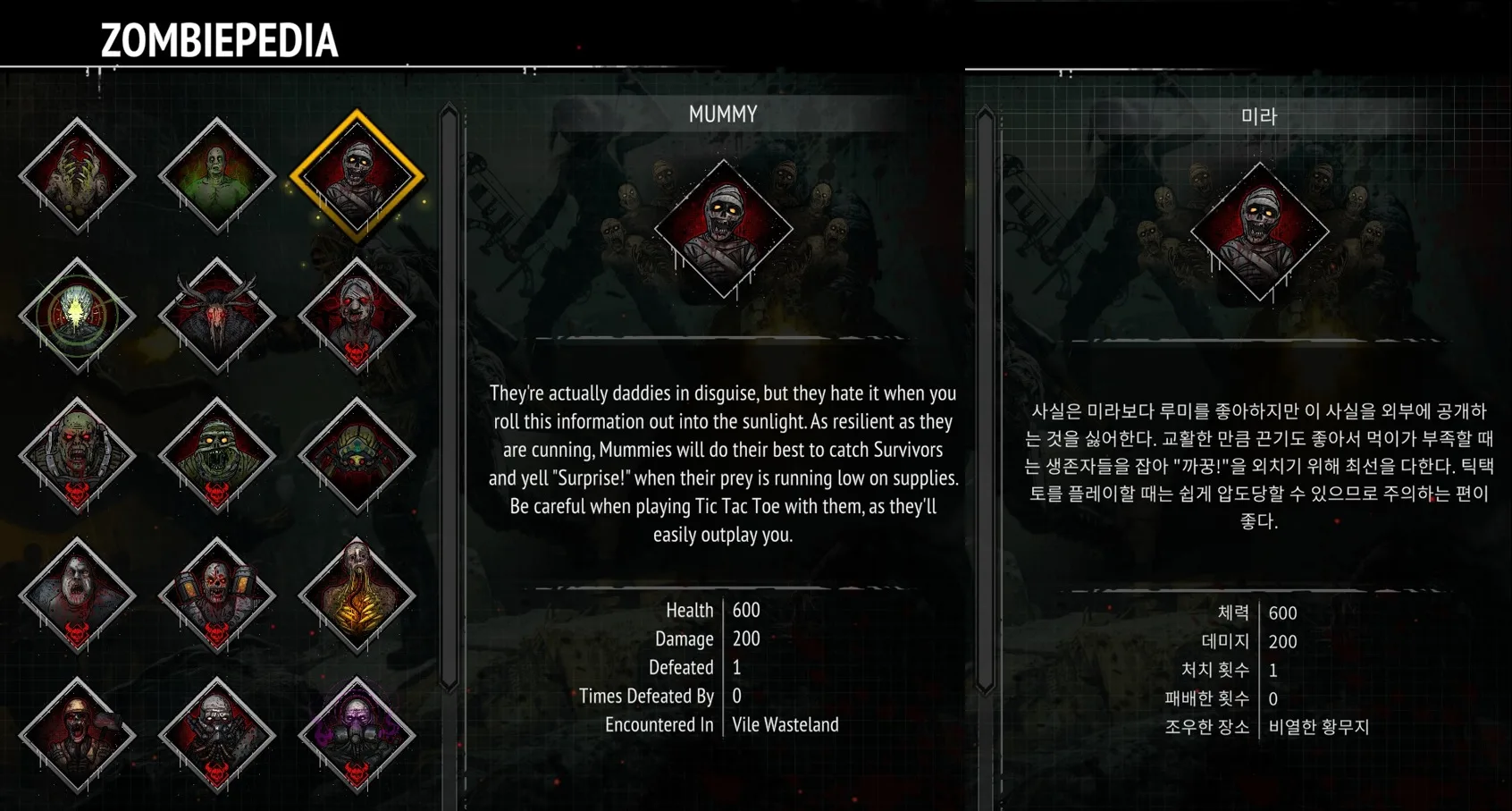
In Korean, "mummy" is 미라 (mira) — and Mira is also the name of a member of the fictional girl group in K-Pop Demon Hunters, the animated megahit of 2025. So the Mummy's description in Korean now implies that the monster has secretly watched the film. It loves Rumi, the group's leader, more than Mira — even though it literally is the Mira. And it hates it when you bring this up in public.
That's an elegant way out of a pun that couldn't survive the trip, built on a coincidence the translator spotted while the film was at its peak.
Making the interface say what it does
Moby sorts game text by how much creative freedom it allows: stats, skill descriptions and interface buttons must be translated with full precision, while flavor text leaves room to play. Much of the content Moby translated from scratch; part of the Chinese text, however, already existed in earlier translations, and he sometimes had to rework those older lines when they got in the game's way.
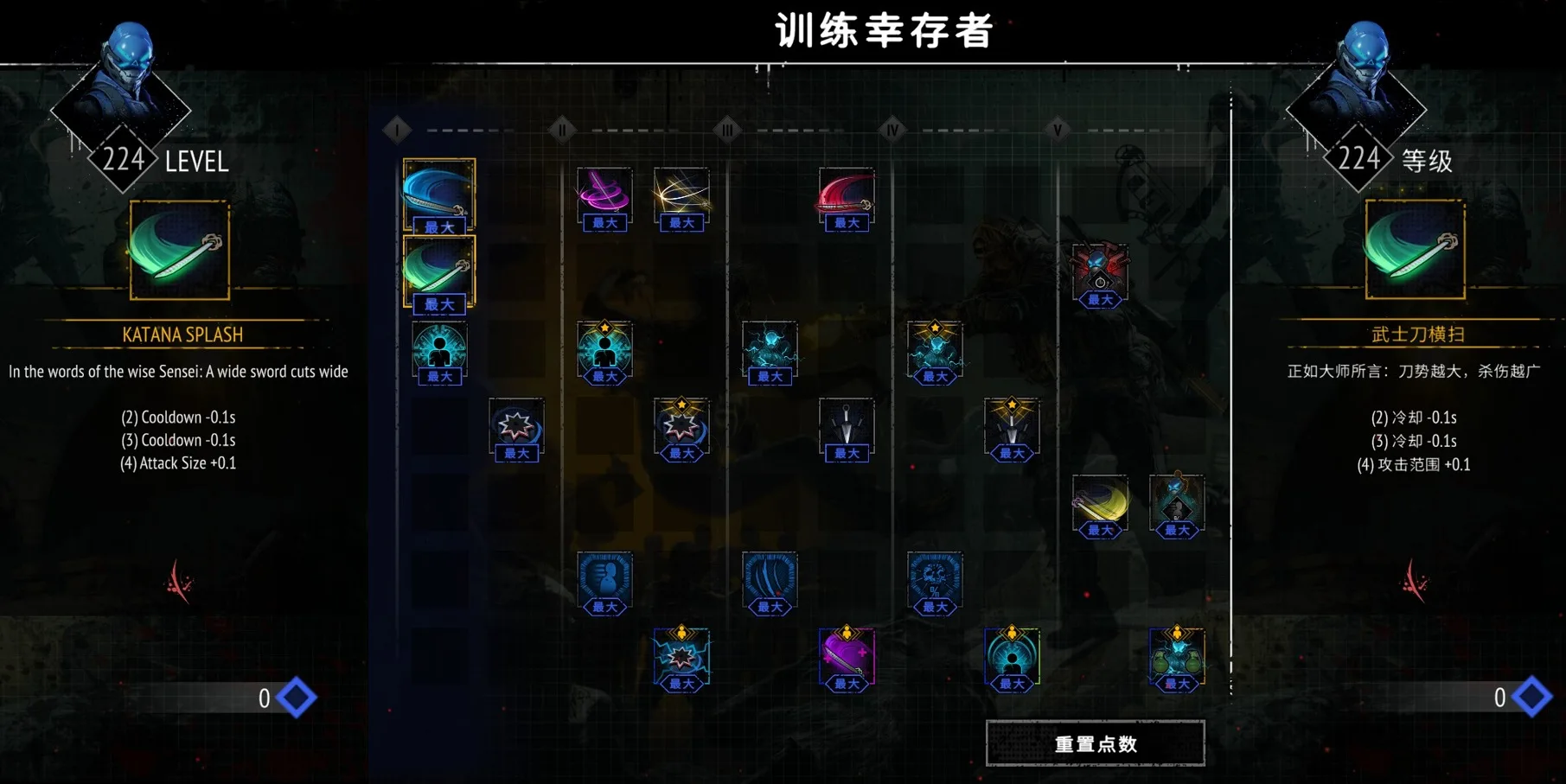
Take Katana Splash, an upgrade for the Ghost character that turns a single-target katana strike into a wide slash:
- Earlier translation: 武士刀溅射 (溅射 is a damage term for liquids and shrapnel — a different mechanic entirely).
- Moby's version: 武士刀横扫 ("katana wide sweep" — the real arc of the blade).
Or the warning banner "The horde evolves." Its earlier Chinese rendering, 尸群会进化, was grammatically fine, but on screen it reads like a statement of fact ("hordes are capable of evolving") when the banner's actual job is to scream incoming threat. Moby had spotted it while playing the demo and fixed it during our work: 尸群即将进化, "the horde is about to evolve." One word changed, and a trivia note became an alarm.
And LQA added style on top of precision. By that stage Moby had hours of play time behind him and a real feel for its atmosphere — and with that feel came better names. He renamed the whole katana upgrade line — 裂风 ("wind-splitting" for Windcutter), 千刃 ("a thousand blades" for Thousand Cuts), 夺魂 ("soul-snatching" for Soul Reaper) — into one cohesive family styled like traditional samurai sword techniques.
Giving each character their own voice
In Japanese, you can't write a line of dialogue without deciding how the speaker talks: the choice of pronouns, verb forms and sentence endings immediately signals their personality. English doesn't force that choice, so Zhao had to make it for every character, and he made it by playing the game.
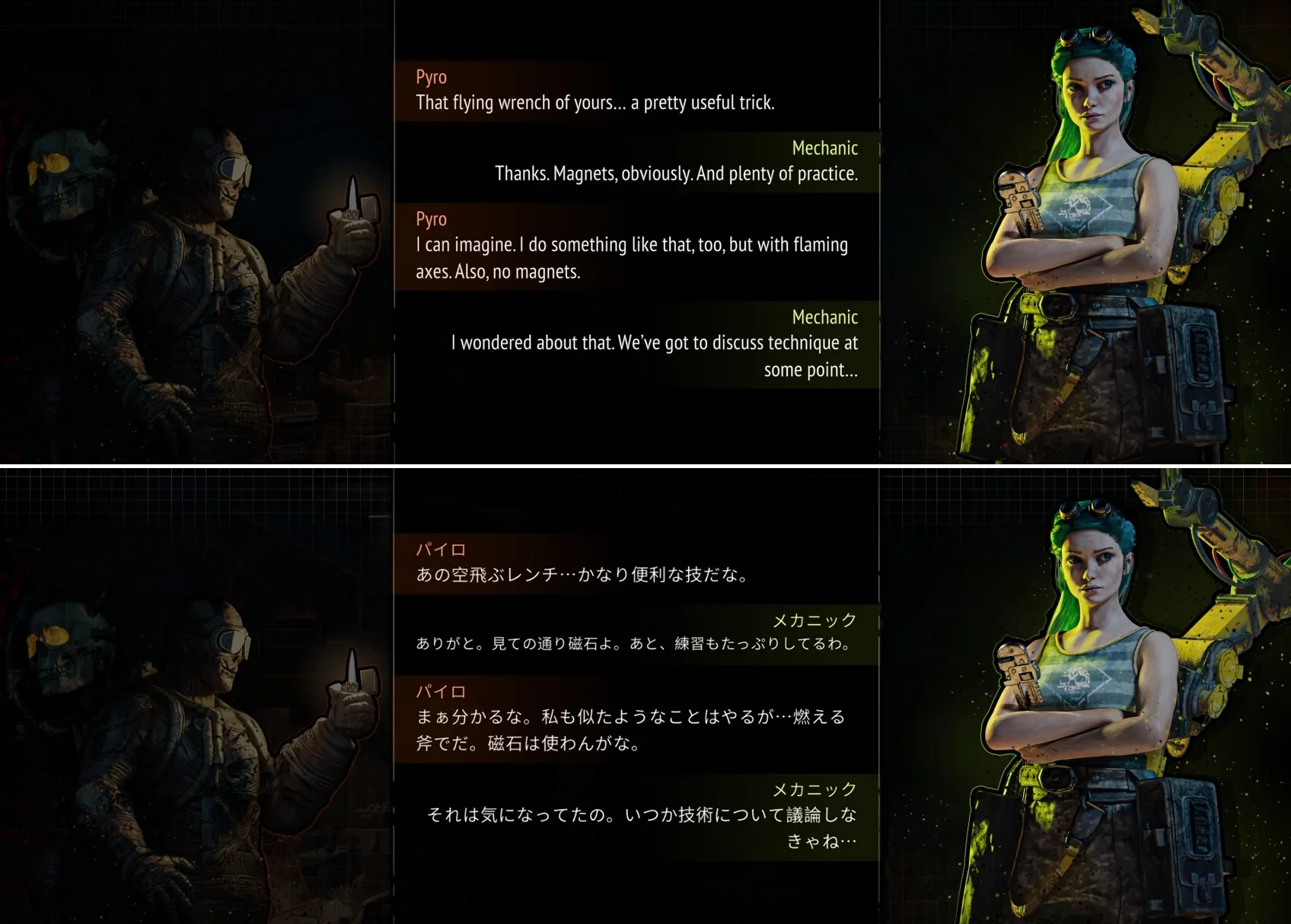
For the map and mode selection screens, I initially used the polite desu/masu tone. But once I actually played the game in action, I realized right away that a casual, non-polite tone fit the atmosphere much better.
The same went for the characters: "Aside from the SWAT guy, who naturally gives off that classic heroic protagonist vibe, I adjusted almost every other character's tone to better match their actual personality and combat style," adds Zhao.
While translating the game into Brazilian Portuguese, Helder noticed the same thing about the English source: reading the line "Ever tried cleansing your chakras?", he points out, "You can't imagine the Medic (factual, scientific) or SWAT (rough) say something like this. Only the Ranger could say that."
You only develop that ear for the characters by spending time with them — which is exactly why it mattered that our translators could play the game.
An invisible bridge, in eight languages
The best translators are invisible. They should be an invisible bridge between the authors and the player.
The paradox of this case study is that to show you the bridge, we had to make it visible: the washing machines, the little potatoes, the mummy with a K-pop crush. In the game, if everyone has done their job, you'll never notice them — you'll just laugh in the right places, in your own language.
We're glad we could support Yet Another Zombie Survivors on its way to players in eight languages — and grateful to Awesome Games Studio for a project our translators genuinely loved. And to developers who annotate their own jokes: it shows, and it works.








































































 QACAT
 AI Video Studio
 Localize.io