
On commonly cited industry measures, gaming is bigger than cinema and recorded music combined.
The global games market generated an estimated $201.6 billion in 2025, according to Newzoo. For comparison, global box office reached about $33.55 billion, while global recorded-music revenues reached $31.7 billion.
And yet growing a game has rarely been more competitive. The market is flooded with more titles than players can get through, and AI is only accelerating the pileup: more teams can create more content with fewer resources, but distribution has not opened up to match. Studios are still competing for attention through largely the same mobile app stores, PC storefronts, social platforms, creators, and communities.
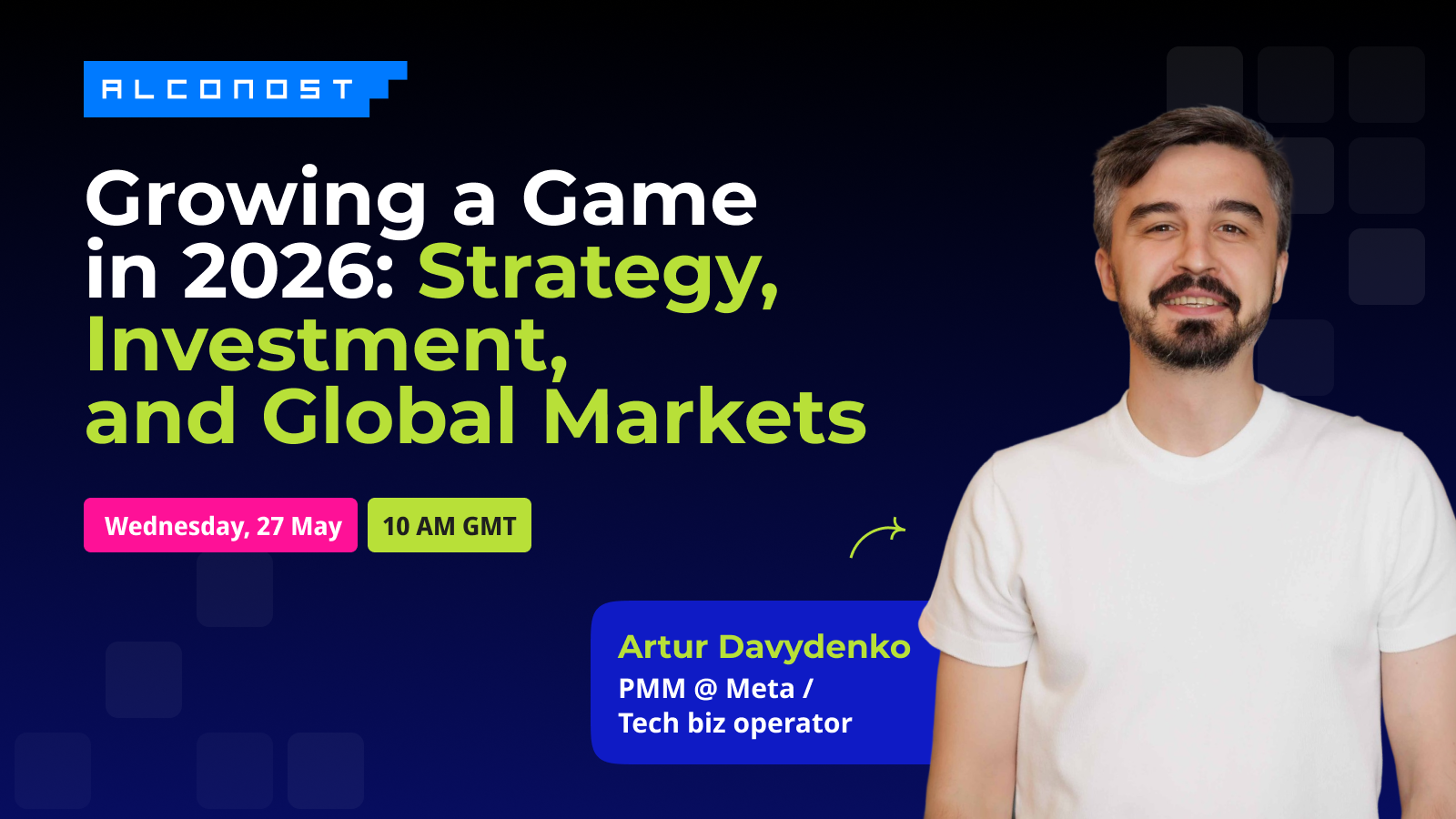
To make sense of what actually works in this environment, we hosted a LinkedIn Live with Artur Davydenko — Product Lead at Meta; board advisor, previously at Google and in venture capital. He brings 10+ years across gaming, tech, and investment, spanning marketing, growth, people management, business development, project management, and entrepreneurship.
On the operator side, that includes raising $1M to launch casual games—leading fundraising, finance, marketing, monetization, partnerships, and communications—and helping an emerging telco app move from purchasing and localizing games to fully in-house game development. As a board advisor, he has also supported an app that raised $700K to improve LiveOps.
This article distills his full take from that conversation—from testing and community to marketing, funding, and global expansion, including when game localization becomes strategy rather than a checklist item.
Full podcast: Growing a Game in 2026 — Strategy, Ops, Investment, and Global Markets
Prefer the full conversation first? Watch here, then use the shorter clips below for the decisions that come up most often: testing vs. shipping, niche community, multi-touch marketing, funding, and going global.
Stop shipping more. Start testing more.
The instinct in a crowded market is to produce faster and release more. That misses the actual bottleneck. On the production side, AI genuinely changes the math: fewer people can make more, especially in art and animation. But distribution has not opened up to match—it is still the same app stores on mobile and the same storefronts on PC, now flooded with far more games chasing the same attention. Producing more just adds to a pile players cannot get through. What separates studios that grow from studios that vanish is the ability to test an idea cheaply and learn whether it deserves further investment before spending months building it.
Artur describes this as moving toward a more R&D-like approach: formulate hypotheses, expose them to players, measure what happens, and carry what you learn into the next iteration. Non-gaming publishers have worked this way for years—treating a launch as a set of hypotheses to validate, not a finished product to unveil.
Stop Shipping Games on Instinct
You need to be able to test more rather than ship and release more.

For creative teams, that shift can feel uncomfortable. Game development often begins with a strong creative vision and a desire to hand players a finished game. Testing introduces the possibility that the audience will not respond as expected. But if the goal is a commercial product, finding that out early is far better than finding it out after six months of development. That does not mean every imperfect prototype should be abandoned—it means the next development decision should contain information the previous one did not.
Build with your audience, not just for them
Testing this way means testing with real players—which means you first have to find them. For small teams and solo developers, Artur’s recommendation is specific:
Go narrower.
Rather than making “a roguelike” or “an RPG” for everyone, identify the particular combination of genre, setting, story, aesthetic, or player fantasy that makes the project distinctive, then find the people who already care about that niche. Fragmented social platforms, for all their downsides, have made those pockets of players findable in a way they were not a few years ago.
Go Niche to Build Community
Go as niche as possible, and double down on the people who like your kind of game.
The payoff is organic discovery—but only if you iterate with those players instead of disappearing for months to build in isolation and returning to the most dangerous response possible:
“Nice game. I wouldn’t pay for it.”
Community-building in this model is not just promotion; it becomes part of product development. It also requires patience. You can publish for weeks or months without meaningful traction, then suddenly have one post, stream, or piece of content reach exactly the audience you were looking for. The goal is not to engineer virality on command—it is to stay close enough to the right audience to recognize a useful signal when it appears.
Decide what you’re actually building
Underneath the tactics sits a decision worth making consciously: are you building primarily to express yourself, or are you building a business you expect to scale? Both are legitimate, but they demand different things.
Production has a goal. Creativity doesn't have a goal.
Creative expression does not inherently need a commercial objective. If someone has another source of income and wants to spend their time building the game they personally want to make, they do not need to optimize every decision around growth. Commercial development is different. If you want a studio that lasts five, ten, or twenty years, you need enough process to understand what is happening—not bureaucracy for its own sake, but measurement. You need to be able to say:
- This idea worked.
- We think it worked because of this.
- This other idea did not.
- Here is what we learned.
- Here is what we will change in the next iteration.
Without that, a hit can stay a one-off the team cannot explain or reproduce.
One ad isn’t a go-to-market strategy
The same measurement mindset applies to marketing. Some mobile acquisition still looks simple—ad → store page → install—but many purchases and installs do not happen after one exposure. Artur points to the multi-touch journey already normal in ecommerce, apps, and larger PC games, and increasingly relevant across gaming. A potential player might:
- See a streamer playing the game
- Encounter a post from an influencer
- Read about it somewhere else
- Visit the store page
- Forget about it
- See another piece of content
- Read reviews
- Finally install or buy
Discord, creator video, Reddit, streams, reviews, store visits, and paid campaigns are not separate universes—they can all sit on the same path. Artur expects game marketing more broadly to become increasingly systematic about those interactions rather than treating one advertisement as the entire acquisition journey.
That journey is harder to measure than last-click conversion. You do not need perfect attribution for every touchpoint—you need a more systematic habit of testing:
- Which messages attract attention?
- Which communities respond?
- Which creators generate meaningful interest?
- Which markets respond differently?
- What happens after the first interaction?
- Which experiments change actual player behavior?
Test, measure, learn, iterate.
Funding the growth
Once a game begins showing signs of commercial potential, another question appears: Where does the money for the next stage come from? Venture capital is one option. It is not the default. Artur lays out several paths:
- Self-funding — when the required budget is small enough
- Friends, family, or lending — depending on personal circumstances and the financial environment
- Angel investors — often writing checks in roughly the $25K–$100K range, often found by showing up at events and asking other founders
- Crowdfunding — especially when you can communicate to a large audience in a major language
- Strategic investors — large game companies such as Tencent, usually after you have credibility
- Venture capital — only when you are aiming at a very large outcome
VC sits apart because its model only makes sense at that scale:
The VC model is to give a million to a hundred people and generate a billion from one.
That makes VC appropriate primarily for founders who want to build a large commercial business for a correspondingly large market. If you are intentionally building a relatively small niche game, taking venture capital may solve a financing problem while creating a much larger expectations problem—and knowing that early saves everyone’s time.
What investors want is changing too
The classic four checks still apply:
- Product
- Market
- Finance
- Team
What has changed, in Artur’s view, is how much uncertainty sits under product and market assumptions. Markets move quickly, products pivot, competitors react fast, and new technology makes experimentation cheaper for everyone. Investors have not stopped caring about the idea; they have started scrutinizing how quickly you can test and learn.
Investors are viciously double-checking the way you will test it, because the competition will increase so much faster—people learn about your success so much faster than before.
In practice, a stronger fundraising story includes:
- The market you are targeting
- The hypotheses you intend to test
- Early evidence or traction
- The infrastructure to run experiments
- Proof the team can move when assumptions change
Team and product still matter—but the ability to demonstrate a credible testing and iteration process has become much more important.
Those are the hypotheses we want to test. This is our first one with the best traction, and this is the infrastructure we have in place to test all these hypotheses. Give us money—we will test it for you.
For studios exploring the VC route, Artur also points to a16z Speedrun and its publicly available material as one way to understand what a gaming-focused accelerator and investor actually expects.
Going global: where localization makes or breaks the game
Growth eventually means new markets, and Artur reduces the commercial evaluation to three unsentimental questions:
- How large is the potential audience?
- What does it cost to acquire players?
- What lifetime value can those players generate?
Market size alone is not the same as market accessibility—emerging regions can look attractive on paper and still require cultural work that few studios have done well.
Why MENA deserves attention
From Artur’s perspective, MENA remains particularly interesting because it combines a large and growing player base with comparatively lower acquisition competition and attractive monetization potential—including higher average spend in some markets than studios often see in Latin America or Southeast Asia. The trade-off is cultural adaptation beyond linguistic localization: reaching those players may mean changing visuals and narrative, not just translating text. Few have done that thoroughly, which is part of why the opening is still there.
External market data supports the broader growth thesis. Niko Partners estimates that Saudi Arabia, the UAE, and Egypt — the “MENA-3” markets it tracks — generated about $2.0 billion in games revenue in 2024 and were on track for approximately $2.2 billion in 2025, with the market forecast to reach $2.8 billion by 2029. It counted 72 million gamers across MENA-3 at the end of 2024 and projects 84.3 million by 2029. Even within those three markets, the picture varies: the UAE leads in average revenue per user, followed by Saudi Arabia, while Egypt combines a much larger player population with significantly lower per-player spending. At the broader regional level, Newzoo reported the Middle East and Africa as its fastest-growing games region in 2025, up 15% year over year.
So “MENA” should not be treated as one homogeneous opportunity. There is growth—and meaningful variation in:
- Purchasing power
- Player behavior
- Platform usage
- Cultural expectations
- Regulation
- Localization requirements
That is exactly why market entry requires more than translating a store listing. Cultural fit is explored further in cultural traps in localization.
Local studios have a built-in advantage
Studios entering another region are not only competing with other international publishers. They are increasingly competing with local developers who already understand:
- The language
- Local social channels
- Player preferences
- Cultural references
- Community behavior
That knowledge can turn into faster iteration. Vietnam has been a mobile-development powerhouse since around 2021; Singapore-based Sea (parent of Garena) has spent years funding Southeast Asian studios into serious competitors. A local studio may not succeed on every attempt, but it can often understand feedback and respond more quickly because it is already embedded in the market. For an outside studio, competing means being disciplined about both speed and measurement. You are not the home team.
Translation and localization are not the same thing
This is where global growth becomes a product issue rather than simply a marketing decision. For purely informational content, direct translation may sometimes be enough. A game is different: players spend hours, days, months, or years inside an experience that includes:
- Language
- Humor
- Narrative
- Art and characters
- UI and pacing
- Cultural references and visual expectations
In entertainment and gaming, translation is absolutely not enough, because it's a story. You can skip a story and find another one in a second.
Players do not need to tolerate an experience that feels awkward or foreign—there is always another game one tap away. If a studio seriously wants to compete in another entertainment market, it has to speak through both language and culture, not merely transfer the words. See also localization vs. translation. Choosing not to localize deeply is valid, but it is a choice to stay successful mainly where you already are.
Adaptation can go much deeper than text
Artur uses Brawl Stars as a cautionary example. Supercell is one of the strongest mobile studios in the industry—and it still took years to land the game globally with a young audience that includes a large share of players in Asia. A surface translation was never going to be enough. Adaptation extended into:
- Art style for local taste
- Gameplay pacing
- Animations
- On-screen text and speech bubbles
- Small mechanics
- The overall rhythm of play—not just static visuals
Only once those layers matched how players actually think and play did the title take off. If a studio with Supercell’s resources needed several iterations to get there, the takeaway for smaller teams is clear: cultural adaptation is a process you work through, not a box you tick on launch day. Market entry should not be treated as translate → launch → done. The product may need to learn from the market too.
So when should localization enter the process?
Artur offers a clean sequence for small and mid-sized studios:
- Start where you can learn — often the home market. Revenue does not have to be the immediate objective. You need players who can tell you:
- What works
- What doesn’t
- What they understand
- What they enjoy
- Where they drop off
- Prepare localization by soft launch — once you soft-launch in target regions, you need economic data as well as engagement data, and you should already be developing a localization strategy for the markets you are testing and the markets you may enter next, because scaling can happen quickly after a successful soft launch.
- Localize marketing last and fastest — Artur’s example is on the order of two to four weeks before a market launch. The product itself is more complicated.
A practical end-to-end process is covered in the game localization workflow.
Different games need different localization depth
One nuance matters more than the sequence: you cannot treat every game the same way.
For a highly intuitive casual game, it may be possible to test a market by localizing only:
- Advertising
- Store pages
—while leaving much of the product in its original language. Players skip the text and just play, which can provide useful early acquisition data. But once deeper retention matters, returning players interact with:
- Features and menus
- Progression and events
- Dialogue and narrative
Those experiences depend much more heavily on language, culture, and context. For a narrative-driven or otherwise text-dependent game, localization may need to happen considerably earlier, because an untranslated product cannot provide a meaningful test of the actual experience. That is also why many Steam narrative titles ship in a wide language set despite the cost—and why mid-core games can be both expensive and lucrative to bring out of their home markets. How deep you go depends on the product. For readiness and process, see game localization and the game localization workflow.
The thread connecting all of this
Testing, community, marketing, funding, market entry, and localization sound like different disciplines, but Artur’s advice keeps returning to the same operating model:
- Make a hypothesis
- Put it in front of the right people
- Measure what happens
- Learn
- Then invest more
That applies when deciding whether a concept deserves another six months of production, whether a community actually cares, which marketing channels work, whether investors should believe you can adapt—and whether another country is a real growth market or simply another language on a spreadsheet.
In a market where technology makes it easier for everyone to produce more, quantity is not much of an advantage. The advantage is learning faster. None of that requires a giant’s budget—the tools to compete are more accessible than they have ever been. What it takes is the will to use them deliberately.
As Artur put it at the end of the conversation:
The world needs creators. The world needs entrepreneurs.
Whichever one you’re building to be, there has never been a better moment to start.
Ready to grow beyond your home market?
Going global isn’t only about translating your game. The right localization depth depends on the product, the players, the market, and the stage you’re at. Alconost helps game teams build localization workflows around those realities—from multilingual translation and contextual workflows to ongoing updates and localization QA.
Artur Davydenko is Product Lead at Meta (Privacy & Compliance / GTM), previously Sr. Product Marketing Manager at Meta. Over 10+ years in gaming, tech, and investment he has worked across marketing, growth, people ops, bizdev, project management, and entrepreneurship—including raising $1M to launch casual games and advising a LiveOps-focused app that raised $700K. Before Meta he worked at Google (Ads and Firebase), as Entrepreneur in Residence at Flyer One Ventures, and in growth roles at Playgendary and game studios including Alpha Games and Kefir. He co-founded HoneyLab Games and advises Balancy and HookRadar. Based in London. This article is drawn from a LinkedIn Live conversation hosted by Alconost.


















































































 QACAT
QACAT AI Video Studio